
Employee Work Engagement
Our predictive model incorporates the Utrecht Work Engagement Scale, the most academically validated method for measuring engagement. This is combined with traditional statistical methods with outputs informing strategies for elevating low engagement, and alleviating burnout.
What is Engagement?
The concept of employees being personally engaged in their work is intuitively appealing. If employees can genuinely be encouraged to invest more of their energies into their role performance, it offers dual benefit: increased well being for employees while organisational benefits arise from the likes of increased customer satisfaction, greater customer commitment, increased productivity, higher quality outputs, reduced errors, higher retention lower absenteeism and ultimately, increased profitability. It creates more productive, resilient organisations and establishes a platform for growth.
The Current Landscape
Despite its importance, engagement is far lower than most realise. Research shows only around 25% of New Zealand employees are genuinely engaged — and up to half are at risk of burnout.
A major cause is the widespread confusion around what “engagement” actually means. Many organisations have simply rebranded job satisfaction or attitude surveys as “engagement” tools. This blurring of definitions has led to programmes that fail to deliver meaningful improvements.
Our Evidence-Based Approach
We start with a clear, academically grounded definition: work engagement — “a positive, fulfilling, work-related state of mind characterised by vigour, dedication and absorption.”
To measure this accurately, we use the Utrecht Work Engagement Scale (UWES), the gold standard validated across countries, cultures and industries.
We also treat burnout and workaholism as distinct constructs, using separate validated scales. This ensures a precise understanding of employee experience — not a one-size-fits-all measure.
Our predictive model draws on:
1. William Kahn’s psychological conditions of engagement (meaningfulness, safety, availability), and
2. The Job Demands–Resources (JD-R) model to identify key drivers and barriers.
All analysis uses transparent, recognised statistical methods — never a “black box”.
Key Outcomes
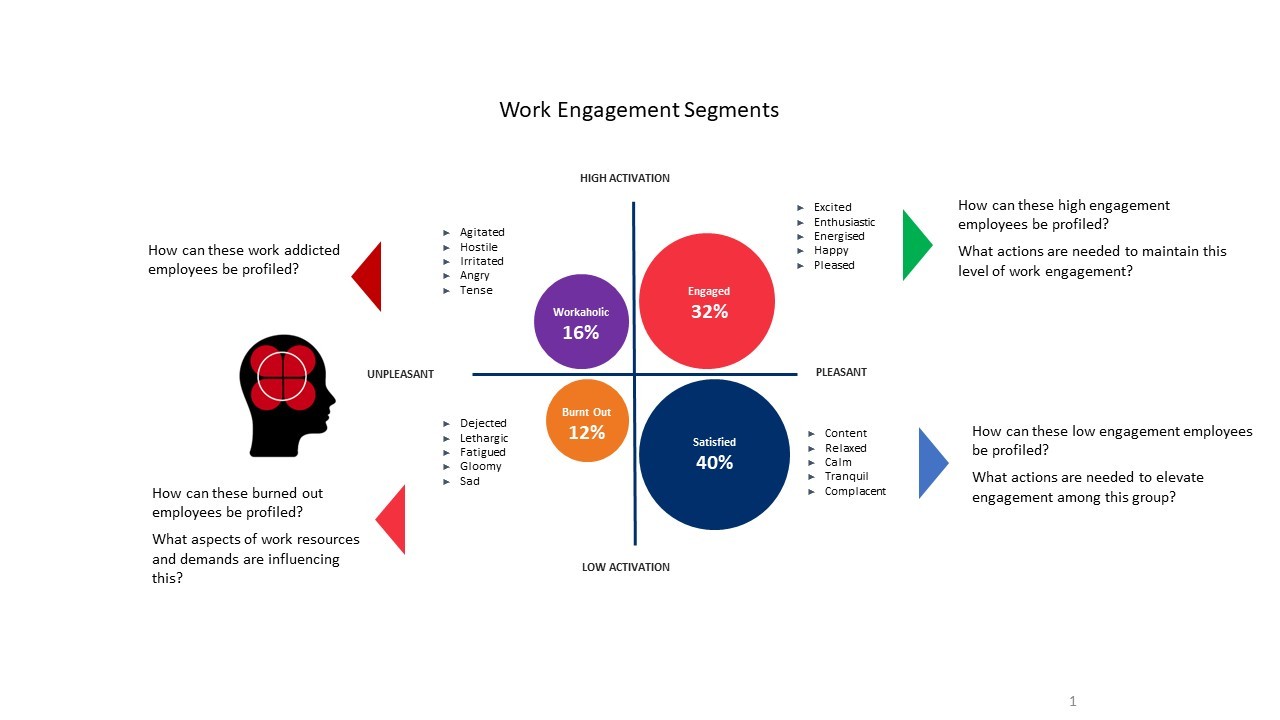
Employees are categorised as engaged when they meet or exceed established UWES norms.
Those below the benchmark are classified as low engagement, unless validated scales indicate burnout or workaholism, in which case they are placed into those specific segments.
This produces a clear, accurate view of your workforce — and identifies the levers that will make the greatest difference.
Contact
Muirton Business Development Limited
PO Box 8378
Cherrywood
Tauranga 3145
Phone: 027 474 1798
Email: Info@muirton.co.nz